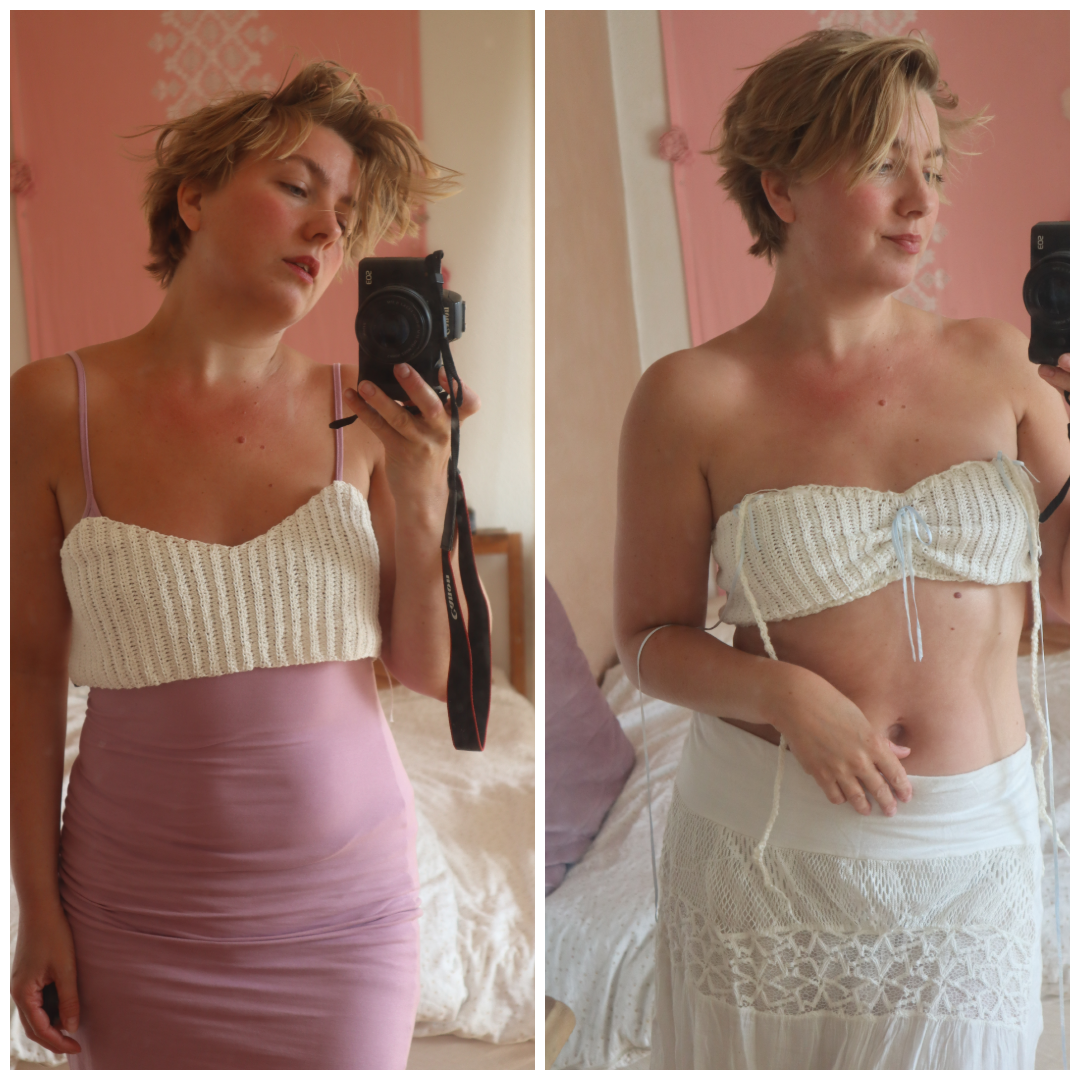
Udforsk feminine og simple hækleopskrifter til kvinder og piger. Her finder du smukt sommertøj, hæklede accessories og sødt hæklet tøj til foråret. Giv dig selv god tid og start i dag, sådan at du har et eller to stykker tøj når varmen og solen vender tilbage. Disse stykker tøj fremhæver din figur, tidløse og mange af dem er i romantisk og feminin sommerhusstil, med fokus på naturmaterialer, komfort, luftighed, bar hud og tætsiddende snit. Gå efter neutrale nuancer for tøj der passer med alt eller gå efter varme eller kolde, støvede pastelfarver som repræsenterer blidheden ved din kvindelighed og forårets kommen, hvor farverne omkring os står tydeligere frem i takt med at lyset kommer tilbage.
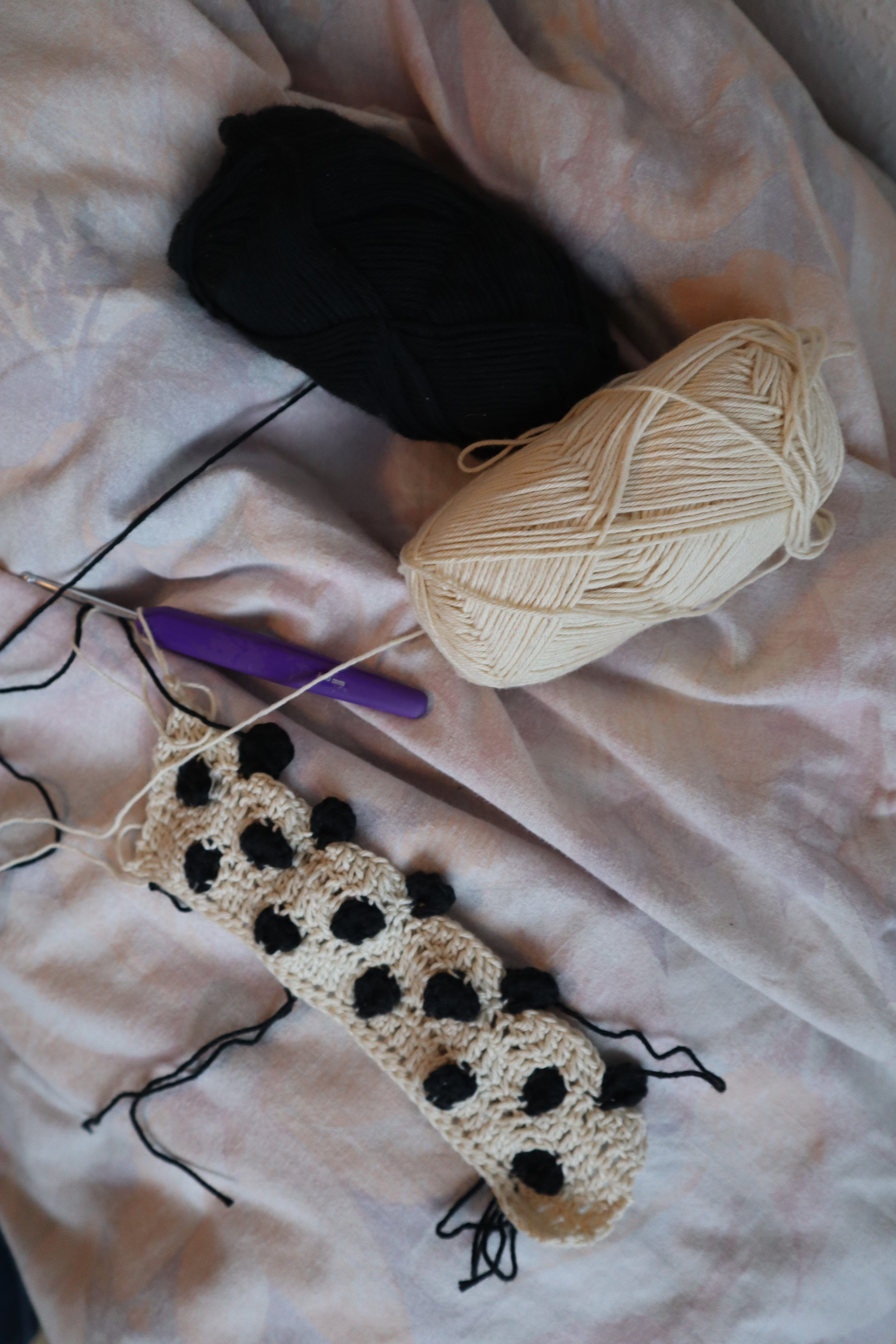
Make sure to only make the dots on every other row and also make sure to add them with spacing between. You can crochet them intuitively and just look at your row where you want them to be.
You need: 3 mm hook & super fine cotton yarn ¤ double crochet.
When you’re ready to make your polka dot, make a slip stitch into the stitch you want it to be and change colour. Chain 4, turn over, 1 slip stitch into the same stitch, chain 1, turn over, 7 single crochet into the hole. 1 slip stitch into the same stitch and change yarn. 1 slip stitch into the next stitch, chain 2, make 1 double crochet into the same stitch and continue the row until your next dot.
When you reach the next row and you reach the polka dot, make 1 single crochet into the 4th single crochet – so into the middle of the dot – only crocheting into the front loop. Continue with double crochet into the next stitches.
Push the polka dot so it pops out on the other side.
How to crochet small polka dots with angles:
Use hdc. When you’re ready to make your polka dot, change yarn by making 1 chain in the new colour – then make a slip stitch in the next stitch, chain 3 loosely, 1e slip stitch in the same stitch – then change yarn by making one chain in the new yarn. Continue wit hdc until your next dot. On the next row make 1 sc in the 2nd of the 3 chains or into the hole of the 3 chains, every time you reach the polka dot.
Use this crochet flower as it is – or add it to crochet clothes or sew together to a bag, blanket etc..
Hook: 3 mm Yarn: Superfine/lace wool, approx. size: 50 g = 200 m Stitches: double crochet (dc), single crochet (sc), chains (ch), slip stitch (ss)
Chain 4, connect to a ring with 1 ss in the 4th ch from hook, chain 2. Make 12 dc in the ring (crochet around the yarn end so you don’t need to weave it in in the end). 1 ss in the 1st dc in the round, ch 3, turn. Switch color now, if you’d like.
1 ss in the first dc, ch 3, 1 ss in the next dc etc. – finish with 1 ss around the first arch = 12 arches, ch 1, turn
1 ss in the first arch. Ch 2, 2 dc in the same arch, ch 3, 2 dc in the next arch, ch 3, 2 dc in the next etc. – finish with 3 ch and 1 ss in the first dc, ch 1
Continue in the same direction: 1 sc in the same stitch (first dc), then in the next arch make: 1 hdc, 3 dc, 1 hdc – repeat and end the round and flower with: 1 ss in the first sc. Break off and weave in the ends.
Cotton vs wool (using same pattern and same hook):
Video guide:
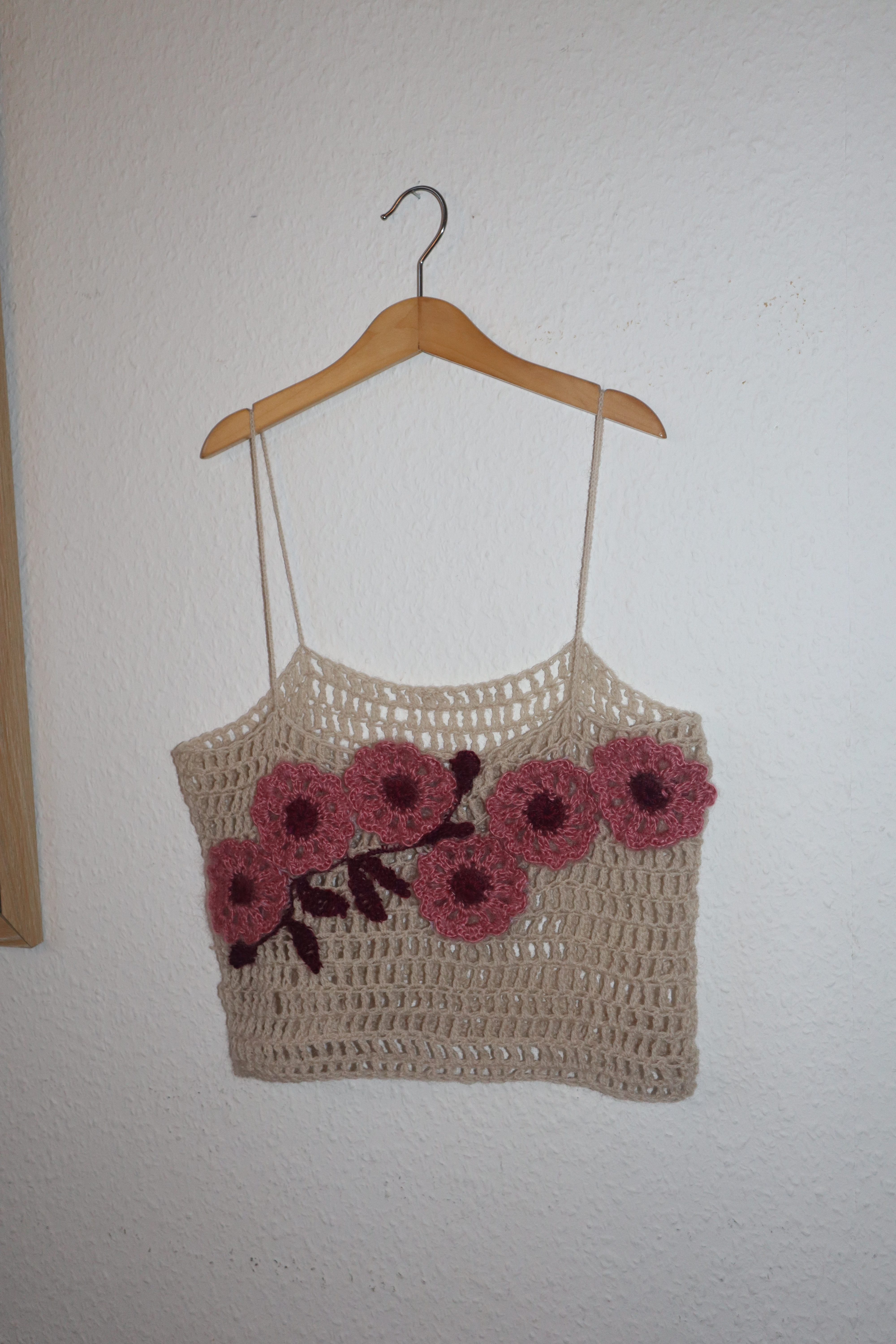
If you want to make this top:
Use superfine wool, 4,5 mm hook. Start with chainless foundation in treble crochet. Stretch and measure on your body. I made 74 stitches, connect in a round, ch 3 everytime you turn and make 1 treble in each stitch. At the end (when you have the length you want – I used 1 yarn ball of 50 g) you break off and tightly chain from about 1/4 of the way into the top, until it can get over your shoulder, slip stitch to the back.
When you attach the flowers you can sew or crochet, I sewed them on. Place them where you want with pins while you wear the top. You then sew only the back of the flowers onto the top. So this would be either into the back loop of the stitches or into the middle of the dc/sc stitch. Only crochet on the back, not all the way through to the front.
I made sure to not sew all the way around each flower but instead only sew on half and then continue to the next flower and so on, because then when I reached the end I could do the other half of all the flowers.
If you want to make the leaves use same yarn and hook: chain 11. make in the following stitches: 1 sc, 1 hdc, ,1 dc, 4 tr, 1 dc, 1 hdc, 1 sc. 1 ss in the 1st sc. Chain 11 tightly. Now you can make one more leaf. If you want 2 leaves next to each other just chain immediately after making a leaf, then make 1 ss in the 1st sc on the first leaf to connect them.
Sew them by sewing into the edge all the way up on both sides of the leaf and down and by sewing stitches around the 11 chains you make – the chains are so small it’s hard to sew through them (and not necessary).
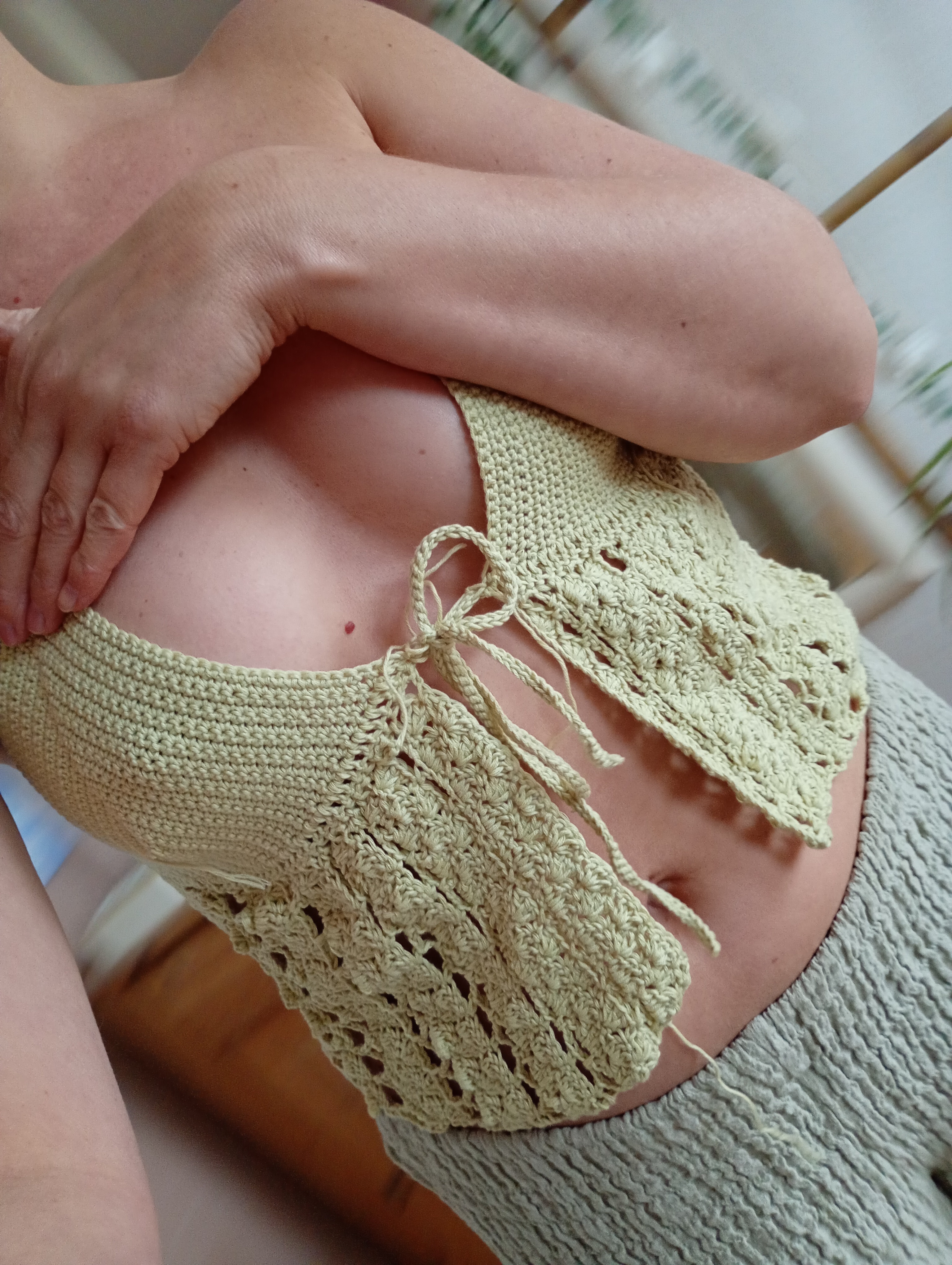
Yarn: Superfine cotton. 50 g = 160 m Hook: 3 mm Stitch: Shell stich (3 dc, 1 sc), dc + dc in chainless foundation, sc, slip stitch, chains.
Use the free bra cup pattern and make 2 bra cups. After finishing the second one, don’t break off. Now onto the body.
Make 1 dc into every hole on the bottom bra cup edge (between 2 sc rows), then make approx the same amount as a chainless foundation in dc (make sure to stretch and measure on your back) I had 44 dc on the bra cup, 44 on the back, 44 on the other bra cup. Continue with dc on the other bra cup.
Stop at the edge and start to chain for the length.
Chain and stretch the chain to see how long you want it. I made 54 chains. Make a number that can be divided with 6.
Chain 3 (turning chains), make the first 3 dc in the 4th ch from the hook. 1 sc in the 3rd chain from the hook, 3 dc in the next ch, 1 sc in the 3. ch etc.
Every shell stitch row is finished by slip stitching into 3 stitches on the bra cup, ch 2 and turn.
3 dc in sc, 1 sc in the 2nd dc in the shell. If you finish with 1 sc, chain, turn and make 3 dc in the sc, 1 sc in the middle of the next shell. If you finish with 3 dc, chain and turn and make 1 sc in the middle of the first shell, 3 dc in the next sc, etc.
Make as many rows as you like, then switch to chains. Always make at least 2 rows with chains.
Make 3 chains, 1 sc in the sc etc. Ch 3 and turn over, 1 sc around the first chained arch, 3 ch, 1 sc around the next arch. etc. You can make sure you make the same number of arches by counting how many you have, sometimes you might have to make one more arch before slip stitching to the bra cup. Always end a chained row at the bra cup by making 1 slip stitch, chain for the next arch and turn over. Make sure to count the number of arches so you make sure to make the same amount on every chained row, sometimes you might have to add an extra arch at the end/beginning.
When you switch back to shell stitch you crochet around the arch and into the sc. 3 dc around the arch, 1 sc in the sc.
Alternate between chained rows and shell stitch and every set of chained rows you make an increase by making 1 extra chain. So 4 chains, 1 sc for two rows, back to shell stitch row(s), next set, 5 chains, 1 sc etc. You do this until you make 8 chains, then you continue to chain 8 everytime you make chained rows. Mark where on the top you made the 7 chains, so that when you reach the opposite side of the top you can start to make less chains in the same spot.
I made a random mix of 2 chained rows and alternating between 1, 2, 3 4, 5 rows of shell stitch. You can look at what you have crocheted and ask yourself: what would look good here: more coverage or more holes?
Once you reach the back you will start to slip stitch into 4 stitches on the bra cup after every shell stitch row. When you make 8 chains in your chained row you finish by slip stitching into 2 stitches on the bra cup.
When you have crocheted on the other bra cup as well you can stop at the corner and chain 80, then slip stitch back to make a strap. Break off an do the same on the other side.
Now crochet 1 sc into each of the 3 sc on the top of the bra cup for a strap. Crochet back and forth until you have enough to reach to the back. Stretch the strap. I had 60 rows.
Slip stitch onto the back and try on. Make more or less rows if needed. I slip stitched mine onto the 17th, 18th and 19th stitch from the armpit.
Crochet on the side of the strap and on the side of the bra cups (the inside). Make shell stitch rows and chained rows (with 6 chains). In order to create ruffle you don’t skip any stitches. Every hole (between 2 sc rows) count as 1 stitch. Make 3 dc in the first stitch, 1 sc in the next, etc. Chain and turn, when you reach the back, slip stitch onto 3 stitches on the back, ch and turn. Chained rows are made like before: 6 chains, 1 sc in the sc, 6 chains, 1 sc in the sc. I made 3 shell stitch rows and 1 chained row. At the bra cup corner where the ties are you don’t slip stitch the side of the ruffles anywhere, cause this is where the front split is.
If you are able to, you can donate small or big amounts to say thanks for the pattern, this way I can continue to share free patterns:
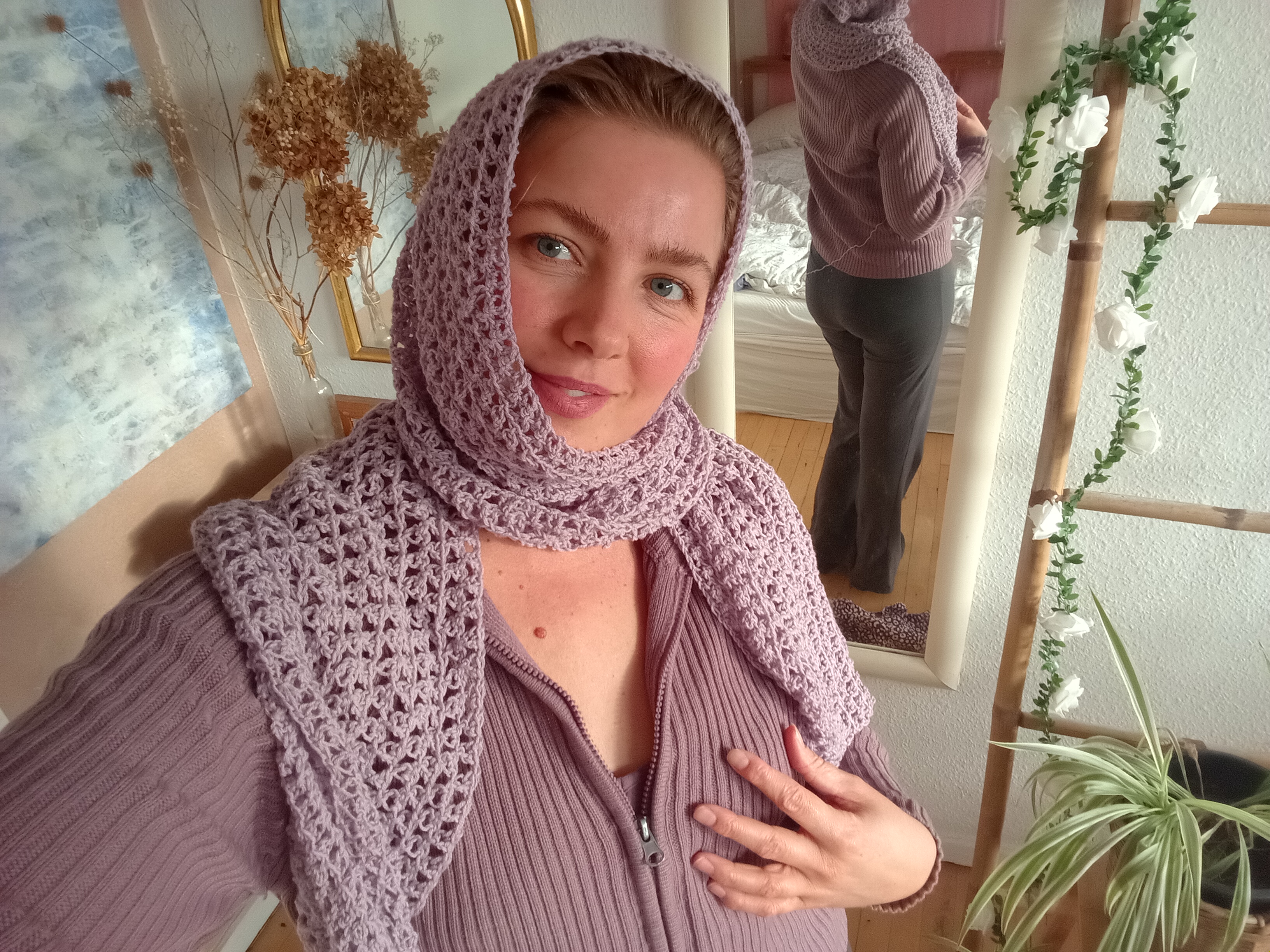
Yarn: Wool & cotton mix. 200 g. Size: Superfine, 50 g = 212 m Hook: 4,5 mm Stitch: Ternion stitch (made in 1 loop (front/back) of the chain from the row before) 1 ternion = *1 dc, 1 sc, 1 ch* Tension: 10 cm = 8 ternion stitches x 8 rows (crochet relatively loosely for a beautiful and soft drape) Size: One size. 194 cm x 33 cm (non-stretched)
Make 274 chains, loosely.
Make the first ternion stitch in the 3rd ch from hook, skip a chain and crochet into the next, finishing with 1 ternion in the last ch, turn
Make first ternion in the last ch of the row before only through 1 loop, next ternion in next ch etc and make the last ternion through both loops in the chain
Her kan du donere et lille eller stort beløb, så jeg kan blive ved at dele gratis hækleopskrifter.
Garn: Uld & bomulds mix. 200 g. Str: Superfine, 50 g = 212 m Hæklenål: 4,5 mm Stitch: Ternion masker (laves i 1 maskeled/bagerste) af luftmasken fra rækken forinden, undtagen sidste lm, her hækles gennem begge maskeled). 1 ternion = *stgm, fm, lm* Hæklefasthed: 10 cm = 8 ternion masker x 8 rækker (Hækl løst for et smukt og blødt fald) Størrelse: One size. 194 cm x 33 cm (uden stræk)
Lav 274 luftmasker, løst.
Lav 1. ternion maske i den 3. m fra nålen, spring 1 maske over og hækl i den næste, kun i 1 maskeled slut af med 1 ternion maske i sidste lm, gennem begge maskeled.
Lav første ternion maske i sidste lm fra rækken før, kun i 1 maskeled, lav næste ternion i næste lm osv, slut med 1 ternion i sidste lm igennem begge maskeled.
Lav ca. 31 rækker, 33 cm eller indtil du har brugt 4 garnruller.
Bryd af og sy enderne ind.
Brug som hæklet halstørklæde, hovedtørklæde, sjal eller wrap.
Her kan du donere et lille eller stort beløb, for at sige tak og så jeg kan blive ved at dele gratis hækleopskrifter.
Hæklenål: 4 mm Garn: 60 g sport/fine, uld/viskose. ca. 50 g = 140 m Masker: fastmasker i bagerste maskeled
Hækl 52 hstgm ved hjælp af luftmaskefri start, vend med 1 lm (vendemaske) Hækl 1 fm i hver maske i bagerste maskeled indtil du har 50 rk, altid med 1 lm at vende på, første maske hækles i sidste maske fra rækken før – fold på langs. Hækl 1 kædemaske i hver m i bagerste maskeled af begge masker. Bryd garnet af
If you are able to, you can donate small or big amounts to say thanks for the pattern, this way I can continue to share free patterns:
Hook: 4 mm Yarn: 60 g of sport/fine, wool/viscose, approx. 50 g = 140 m. Stitches: single crochet in back loop
Make 52 hdc in chainless foundation, ch 1 (turning chain) Make 1 sc in every stitch in the back loop until you have 50 rows, always turning over with 1 chain, crocheting the first stitch in the last stitch of the previous row – then fold in half on the long end. Slip stitch through the back loops on every stitch. Break off.
Denmark is a small and flat country – the highest point is situated 172 meters above sea levels, this means that everything feels very within reach, small and cosy. With the big nordic countries surrounding us and protecting us to the East, England to the West and the rest of Europe to the South it makes this place feel like a cosy oasis.
t will take you less than 1 hour to reach the shore, no matter where you are. It is especially noticable how small the country feels after being in a country with mountains. Not being able to see that far, gives you a feeling of comfort – everything you need is within close reach and I think that is why in the olden days community feeling with those living close to us, was strong.
Our argiculture has always been a part of our country, with 60% of the land being used for crop fields but we also have a lot of forest – about 625.000 hectare.
Nature is a big part of our culture and when you look into poetry, novels and songs it is a recurring theme along with a love for our country and our language, which is not spoken anywhere else.
Hygge – the Danish word for having a cosy, warm and/or social time can also be transferred to your fashion style. Especially using crochet items for comfort and unique self-expression as well as some tips you’ll learn how to incorporate the hygge lifestyle into your life. It’s all about being comfortable, down-to-earth and minimalistic, however that feels to you.
A great thing about Denmark and fashion is that even though many go for simple styles, it is not unusual to see someone with their own unique style expression. Even though we are known for our clean, minimalistic furniture, fashion and architecture and even though we Danes can be reserved you still see many different styles in the streets and there is this part of our culture – hygge – that is still so deep in our veins and lifestyle, that we will always have this element of a cosy, old-timey and warm feeling. No matter if you go for neutral or colorful clothes – hygge can always be a part of it. So let’s get into it!
All the sweaters: Neutral, colorful, ribbed, mesh or oversized
Danes are often seen in timeless, neutral pieces, minimalistic clothing and often looking both comfortable and stylish. You’ll see families going for walks in the city with practical boots, puffer jackets or Nordic sweaters, fleece jackets or long or big coats are also quite common. Sweaters are an important stable as it keeps you warm and can go with jeans, skirts or over a dress.
Denim is timeless and goes with everything and ribbed clothes is also classy and timeless. Pair a ribbed neutral top with an oversized blazer in dark blue or black (look in the Men’s section at a secondhand shop) or a comfy cardigan in another blue shade. Go for simple jewelry like silver or gold, a simple chain or two around the neck or some elegant earrings or studs.
A splash of color
Pink is rarely seen in the streets, most people – especially in Copenhagen – wear black or beige. But if you are into colors go for a simple short or long sleeved top, a skirt or a pair of flared leggings, then add a colorful crochet rose on the top or throw a colorful crochet poncho over the outfit – comfy and easy while still being very stylish. Choosing 1 color or just 1 colorful item with an otherwise neutral outfit keeps it looking simple and not overdone.
You don’t see much crochet clothes out in public (mostly it’s crochet bags)– here is where I come in. I focus on adding that unique element to an otherwise often genderless and a bland palette. So if you’re someone who wants to stand out, like dressing uniquely and in your own style then combining crochet with Danish style is right up your alley.
Materials & fabrics
Danes love quality. So in terms of clothing, go for comfy and natural fabrics: wool, cotton, viscose .- so your skin can breathe. Something you see a lot is when someone haves a child, what the child wears becomes extremely important. Many babies sleep in their strollers in the garden, on the terasse, backward or outside a café (even in winter) so it’s crucial that the baby is warm but not gets overheated (polyester is the worst for this!). Many will use cotton and wool has natural both warming and cooling effects as well.
1 blue item, 1 white top, 1 neutral tote
Pair a blue item (could be denim) with a tank top, sweater or t-shirt and a beige colored tote to carry your belongings. I think blue is also a quite neutral color, it leads your thoughts to denim – a durable and practical fabric that in style and color goes with anything. Here you can keep the color palette neutral without looking to beige-ish.
Neutral tones and ribbed clothes
Add one item of color to break the palette a bit or keep it completely neutral if you prefer. Crochet clothes in rib stitches is great for both comfort and style and it goes with almost anything. You can also try arib crochet skirt.
Hygge – A Danish concept Hygge, both a noun and an adjective, doesn’t have a direct translation but is a very Danish thing that is used not only in terms of our lifestyle but just as much our food, clothes and interior. It can translate to feeling cosy, warm, comfortable and relaxed. All in all it’s about bringing that cosiness, warmth and light into your life, specially the darker months (it seems dark in the North like half of the year).
Here’s how you can bring some hygge into your life:
light a candle or use warm lighting
drink something warm
eat something comfy and delicious
bake or cook some comfort food
be with loved ones or hug a pet or a teddy
put plans on hold and take time to just be
watch something you really enjoy
cosy up under blankets or a duvet
wear something comfortable
crochet something – or use your hands for a cosy craft
Beaches in Denmark
You can’t say Danish or Denmark without saying beaches.. Cause there is something so magical about the Danish beaches – they are very cosy and realxing, often with natural surroundings like sand dunes, rose hip bushes and small cliffs where swallows fly low before the rains. On these natural beaches you’ll often find snarls and reeds and many beaches I have gone to also have a forest nearby. When you go into the dark forest after being in the sun all day, it feels very dream-like and a special kind of peace is found in there, a contrast to the open, bright and sunny beach. You go from constant sound of waves to complete quietness.
In the summer, when I was a child, me and my family would take trips to the beach – often for (what felt like) an entire day. In the morning we would prep a big Danish lunch (smørrebrød with fresh toppings like cooked potato, mayo, onion, radishes, cherry tomatoes, carrot sticks, fresh chives etc) to take with us, and eat on a big blanket on the sand in our bathing suits with wet hair and the sun on our skin. I remember that I would always exfoliate my skin with the sand while in the water or float fon my back with ears under water and listen to the sound of water trickeling on the small rocks beneath. It’s not just a swim, it’s taking care of body and mind and existing in an envioronment where you can let go, not have to do anything other than let the water carry you, the sun charge you, the food nourish you and the sound of the waves calm you. It’s a holistic health practise. And it doesn’t stop at beaches, many Danes love nature – whether it be parks or woods or going to one of the many cemeteries to chill on the grass.
On my last beach trip I brought a crochet project & finished the day with an open faced fresh sandwich (smørrebrød), a stable in Danish cuisine
Going to the beach as a Dane is something that many people not only do in summer but in winter too. Some will swim in the harbour and do cold plunges to keep their health in check. So no matter what kind of beach-goer you are, it is an ingrained part of Danish culture and a way for us to wind down and take a break and care for ourselves.
Beaches in Denmark to me smells like fresh salt water, rose hip and warm sand.
Danish nature
We love nature and nature is a part of our daily life – even when living in the cities. Many bike through parks and cemeteries and we even have a bike path called “the green path” in Copenhagen that leads you quickly and effectively away from traffic and through the city, past trees and kolonihavehuse. Nature is a part of our health and well-being, both in terms of exercising outdoors in summer and winter, going for walks in the weekends with a to-go coffee, going camping or sitting by the ocean or the lakes and looking at the water. It is not only about movement in nature but also about relaxing, getting natural stimuli from the colors and sounds and sensations of walking or sitting on the earth. If you want a more hygge vibe in nature, make a picnic with a blanket and some light food, you could also bring a deck of card or your crochet project.
Denmarks romanticism
In both art and arciteture romanticism lives on in Denmark – from the famous Skagen Painters (Skagemalerne) to the beautiful old houses that you’ll find in all towns and cities, there is this cosy and old-time-vibe. Just go for a stroll in the oldest part of Copenhagen and be mesmerized by the crooked and colorful houses, used for living or as shops or go to Bakkehuset – an old museum house where some of the most famous Danish writers and poets used to visit, take a trip to Søndermarken or to our two amusement parks – Bakken and Tivoli – number 1 and 2 oldest amusement parks in the world, and you’ll get the idea of how much Danes appreciate history, tradition, cosiness and… well, fun!
Hvis du har mulighed for det, kan du donere et lille eller stort beløb, som tak:
HVAD ER DET? En hækleopskrift til et par korte, ribbede og enkle hæklede bukser med elastik i taljen. Der er mindre stof omkring taljen for at skabe et mere tætsiddende og figursyet look. Fra hoften og ned er benene lige. Du kan stoppe med at forbinde siderne for at lave slidser. Mål altid din første række mod din krop. Og mål undervejs.
Når du måler din fulde længde (“mål 1”), skal du måle fra talje til ankel. Hvis du ønsker en almindelig længde, skal du tilføje ca. 5 cm til målet.
Opskriften følger målene og har et proces-foto, der viser, hvordan panelerne ser ud individuelt, og hvordan de er sat sammen.
Bukserne er lavet i 4 paneler og derefter syet eller hæklet sammen i enden. Bagsiden er større end forsiden. Hvis din talje er større end eller tættere på dit hoftemål, foreslår jeg, at du laver Daphne-bukserne i stedet – som er lige.
MATERIALER
Elastik. 3 cm bred. Måler din talje minus ca. 5 cm. 3 mm hæklenål Bomuld/bambusblanding Størrelse 2/sport/baby Garnlængde: 50 g = 118 m.
Jeg brugte 1400 m (593 g) til min størrelse “medium” (længde: 79 cm, hofte: 104 cm). Tilføj/fjern 117 m (75 g) for hver størrelse (4 cm i omkreds, 2 cm i længden) op/ned.